A Word From: Fiona Powrie

cshl-trim-17-fiona-powrie

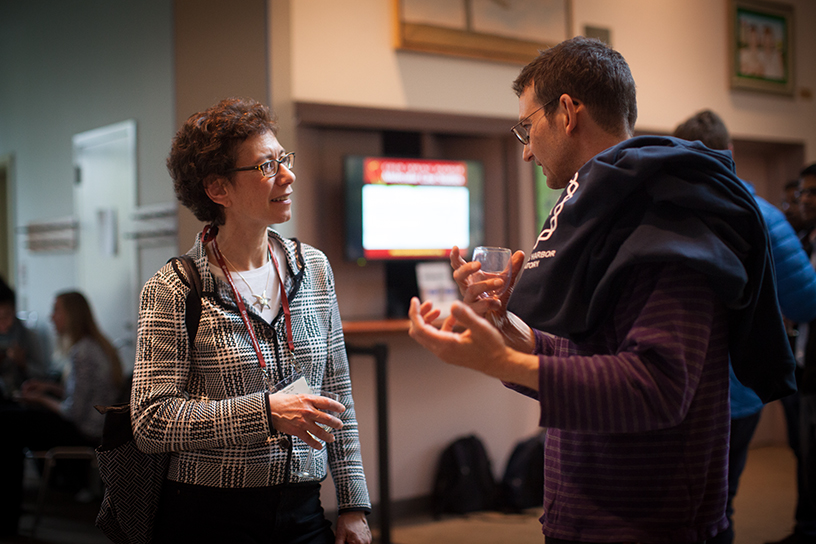
This week, we hosted the second CSHL meeting on Fundamental Immunology & Its Therapeutic Potential and chatted with Fiona Powrie, a returning organizer for the meeting. During our conversation, Fiona mentioned the extensive dialogue among attendees around cancer immunology; and in fact: The number of oral sessions related to cancer immunology has doubled since the last iteration of the meeting in 2015. 

There's been a real buzz around the place and a lot of exciting data presented. One of the features of this meeting that's different from the other meetings in this area...is that we've had a large number of early-stage scientists who've just set up their labs presenting really new data that has stimulated a lot of discussion from the PhD students and postdocs. 
There's been a lot of discussion actually - and you can't stop immunologists talking so there is always a lot of discussion - around new insights in cancer immunology and how we recognize pathogens. There was a very interesting section in regulatory T-cells with some new findings about their specificity, how they're functioning, how they're selected. Of course, that opens up a lot of new avenues across the area of autoimmune and infectious diseases. 

For more on Fiona's research, visit her lab's website. And for more conversations with our other meeting organizers and course instructors, go here. Also, to gain a meeting-goer's perspective on this meeting, read our Q&A with Holly Algood.

Visitor of the Week: Holly Algood

cshl-visitor-holly-algood

Meet Holly Algood of the Vanderbilt University Medical Center and Department of Veterans Affairs. Holly, an assistant professor as well as the head of her own lab in the Division of Infectious Disease, attended the 2017 meeting of the Fundamental Immunology & Its Therapeutic Potential where she presented a poster. Read on to get her take on the meeting and what she liked most about Cold Spring Harbor Laboratory.

What are you working on?
I am interested in the development and regulation of inflammation during chronic bacterial infections.  

What is your key takeaway from the Meeting?
We (Immunologists) are making some great progress towards finding targets and developing new therapeutic tools to combat immunologically related diseases and cancer. This has progressed much more rapidly with new technologies being coupled with bioinformatics.

How many CSHL meetings have you attended?
Two. My first CSHL meeting was in 2013 and on a different topic - Microbial Pathogenesis. 

Is there another CSHL meeting in your near future?
I am not sure yet. I have collaborators attending the Microbial Pathogenesis and Host Response meeting in September.

Was there something about the Fundamental Immunology & Its Therapeutic Potential meeting that drew you to attend?
The list of speakers for this conference really drew me to this meeting and having been to a CSHL meeting before I knew that the atmosphere is very nice for networking and sharing data. 

If someone curious in attending this meeting asked you for feedback or advice on it, what would you tell him/her?
I would tell them that it's a small meeting where many people are willing to share unpublished data and are open to comments and criticisms from their peers. As a small meeting where the food, housing and meeting are all 'on campus', it provides a great opportunity to network and meet scientists from all over. Interestingly, this meeting was very different from other meetings I have attended with several biotech companies in attendance.

What do you like most about your time at CSHL?
I love the international atmosphere. There are less than 250 people here, yet I have interacted with people from many different countries - including India, China, Sweden, Germany, France, Spain, Italy, Australia, the Netherlands and Brazil.

Thank you to Holly for being this week's featured visitor. To meet other featured scientists - and discover the wide range of science that takes part in a CSHL meeting or course – go here.

A Word From: Cynthia Wolberger

cshl-ubiquitin-meeting-cynthia-wolberger

This week, we hosted the ninth CSHL meeting on The Ubiquitin Family. This biennial meeting attracts molecular biologists who study a particular family of cellular proteins called ubiquitins. A great number of the meeting participants are junior scientists: In fact, 47% of this year's meeting are graduate students and postdocs, and 77% of them were selected to present a talk or a poster.

We checked in with Cynthia Wolberger, a CSHL meeting veteran and returning Ubiquitin Family meeting organizer, for a casual chat about the meeting and its role in the ubiquitin community.

We have an exciting mix of talks. From the very basic biochemistry and structure that explains the mechanism of how ubiquitin works, through its effects in live organisms, all the way through to drug discovery where people are finding novel ways of targeting these pathways and treating diseases such as autoimmune diseases and cancer. It’s very exciting to see the full range of all of that science presented together.

The other always exciting thing to see is the junior investigators. Graduate students, postdocs, people about to transition to become new assistant professors, presenting their work, doing such a FANTASTIC job. And watching as the next generation of investigators in this field go off and become independent. 

I look at some of them sometimes and marvel at the work they’ve done and I think, “I didn’t do anything close to that important or groundbreaking when I first started out!” But so much more is possible now.

For more on Cynthia and her work, visit her lab's website.

For more conversations with our other meeting organizers and course instructors, go here. Also, to gain a meeting-goer's perspective on this meeting, read our Q&A with Judy Ronau.

Visitor of the Week: Judith Ronau

cshl-visitor-judith-ronau-yale

Meet Judith Ronau of Yale University. Judy is a postdoc in Mark Hochstrasser's lab and a CSHL first-timer. She is on campus for The Ubiquitin Family meeting and shares amazing feedback about the meeting and why you should attend its next iteration in 2019. 

What are you working on?
I am working on a bacterial protein that induces sterility in insects. In particular, I am focused on studying its biochemical and structural properties.

What is your key takeaway from the Meeting?
A lot of spectacular science has been discussed, but in my opinion, one of the most exciting new directions in the ubiquitin research field has to be ubiquitination independent of the E1, E2, E3 enzymes (+ATP) in the canonical pathway. This fascinating work has been discussed so far by Chitta Das and Sagar Bhogaraju, with a third presentation from Ivan Dikic today! I was also thoroughly impressed with the work from Kylie Walters' lab in mapping ubiquitin binding sites at the proteasome!

Was there something specific about The Ubiquitin Family meeting that drew you to attend?
Having recently entered the ubiquitin research field after doing my PhD on a metabolic metalloenzyme, I wanted to come to this meeting to see what everyone is up to and make some solid connections. Also, this is the perfect opportunity to give a talk on my work and catch up with old friends.

If someone curious in attending this meeting asked you for feedback or advice on it, what would you tell him/her?
COME TO THIS MEETING!! There is a lot of interesting ubiquitin related research in a focused environment. Plus, the setting at CSHL is amazing. Every scientist dreams of coming here.

What do you like most about your time at CSHL?
It is really special just being here to appreciate the history of this place and seeing all of the pictures of legendary scientists in the bar. I have also really enjoyed strolling around the campus.

Thank you to Judy for being this week's featured visitor. To meet other featured scientists - and discover the wide range of science that takes part in a CSHL meeting or course – go here.

A Word From: James Faeder

L to R: Jorge Zanudo, Carlos Lopez, James Faeder

L to R: Jorge Zanudo, Carlos Lopez, James Faeder

This week, we hosted the biennial meeting on Cellular Dynamics & Models, which brings together experimental cell biologists with mathematical and computational scientists. It debuted at CSHL in the mid-2000's as the Computational Cell Biology meeting, and one of the features that makes it unique is the integration of software tutorials into the regular program. James Faeder, a longtime participant in the meeting, organized a tutorial at the 2015 meeting on a software package his research group developed to model and visualize biochemical reaction networks (BioNetGen), and he helped organize the entire meeting this year. We caught up with James for a quick Q&A regarding the meeting and its tutorials. 

We have a great collection of leading researchers in the modeling community -- people who are developing all kinds of advanced tools for doing mechanistic modeling, statistical modeling, and discovery -- and we then combine many of those people with leading experimentalists who have a quantitative orientation, either in cell biology and molecular biology, to study signal transduction or metabolic regulation. By bringing these people together and getting them to talk, I think we foster a lot of new collaborations.

Actually, I was talking this afternoon at lunch with Tom Pollard and he said, “You know, I know about half of the people here and the other half is new.” It’s really great to be interacting with new people and learning new things about what people are doing. And you know many of these people are working on related fields. Maybe they’re studying different organisms so that you haven’t encountered them at the standard meetings you would go to, or maybe they’re studying slightly different molecules, or they’re using different methods, so we really learn a lot from each other.

Here's what James had to say about the tutorials:

This year we took tutorials from the abstracts and we had nice a turn out. That people want to do that and reach this community, I think is a sign that the idea of the tutorials is gathering momentum...It’s a great opportunity for people who do primarily experimental biology to come and learn about some of the tools, or for other modelers to learn about innovative things that other software developers are doing in the modeling community. 

Thank you to James for taking the time to chat with us; and for more conversations with our other meeting organizers and course instructors, go here. If you're interested in learning more about what else James is working on, make sure to visit his lab's website

Cellular Dynamics & Models will be back at Cold Spring Harbor Laboratory in 2019.