

To provide our course trainees with additional insight on the #cshlcourselife, we prepared a multi-part series that will equip them with the information they need to prepare for their life at CSHL. This informational series will cover the different stages in one’s #cshlcourselife; and this first post covers information related to pre-arrival details such as acceptance letter, visas, and making travel plans.
A Word From: Dana Pe'er

This week, we hosted the 30th CSHL meeting of The Biology of Genomes. Over the past three decades, technology in the field has changed; a change that is reflected in the image above. We checked in with Dana Pe'er, a Biology of Genomes meeting organizer and regular, to get her thoughts on the emerging technologies that are showcased front and center at this year's meeting.
The Biology of Genomes meeting is the highest-quality genome meeting. I think what makes The Biology of Genomes meeting special is its combined goal of making sure to cover in-depth the core questions of the field, while also covering all of the emerging and leading topics of the genome field so attendees can get up-to-date of what’s going on in genome biology and, yes, it’s really an expanding, growing field so there’s lots of things. The meeting successfully combines and finds a balance between the core questions of the field and the newest most exciting trends and findings.
As mentioned, this meeting is uniquely dedicated to a core depth. It never forgets the basic, core question of what are the forces that act upon our genomes? How have the genomes evolved? How do complex traits emerge from this genome? The meeting commits a dedicated fraction of the program to discuss the core forces that created this very, very, very complex object and really tries to grapple in a very serious, deep and rigorous scientific way about this object itself and the forces that created it and how it works.
Two exciting, emerging developments in the field are single cell biology and genome editing; both fields are growing at a rapid pace. Single-cell technologies enable us to measure DNA, RNA and epigenetic modifications at a single cell resolution and are opening entire new opportunities in using genomics to unravel biology’s mysteries. Most predominantly single cell RNA-seq is enabling a new understanding of how our genome gets translated into function. So single cell genomic technologies and the opportunities they open, I think, is the most rapidly and most exciting topic in genome biology and we’ve certainly seen some talks about this here.
Now, with CRISPR and other genome-editing technologies, we can do amazing things to perturb, probe and alter the genome again opening up previously unimagined questions about genome function into the realm of possibilities. Indeed, we see lots of uses of genome editing in the talks, with CRISPR being the dominant technology. What can be done now that we can manipulate, engineer, synthesize the genome and not just passively observe it? Interestingly, one of the keynotes described how one can combine both CRISPR and single cell RNA-seq to crack open an understanding of cellular circuits and regulation.
Thank you to Dana for taking the time to chat with us. For more conversations with our other meeting organizers and course instructors, go here. Also, to gain a participant's perspective on this meeting, read our Q&A with Federica Di Palma and Andrew Rendeiro.
Visitor of the Week: Federica Di Palma & Andre Rendeiro
This week's edition of Visitor of the Week is a double feature! We approached two meeting participants of The Biology of Genomes meeting - one a newcomer and the other a veteran to this meeting - and below are our individual Q&A chats with Federica di Palma and Andre Rendeiro. Read on to meet them.
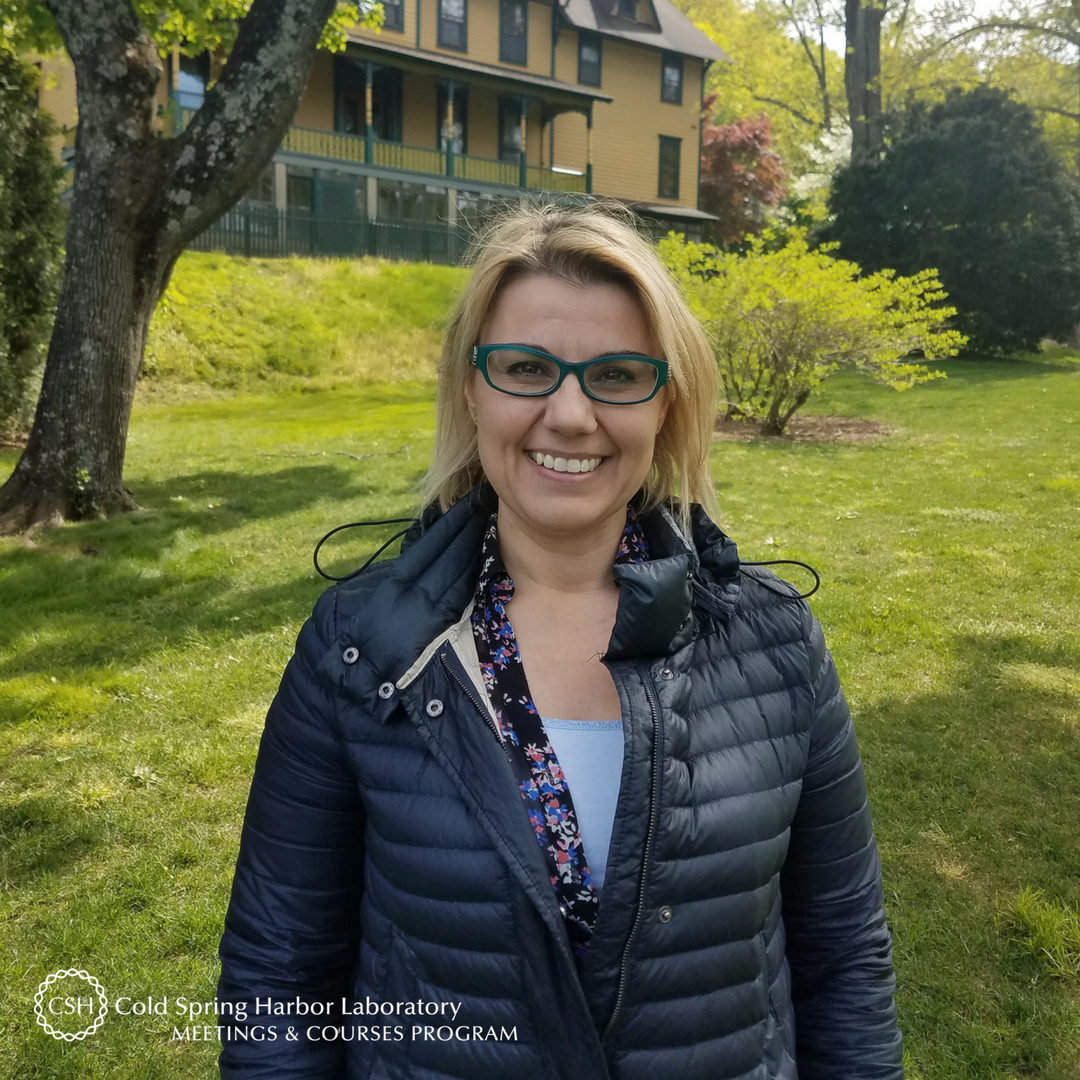
Meet Federica Di Palma, Director of Science of the Earlham Institute (United Kingdom) and Professor of Regulatory Genomics at the University of East Anglia (United Kingdom). Federica is back on campus for The Biology of Genomes and to support two junior scientists who she works with and who were each selected to present a talk. Read on for what and why Federica keeps returning for The Biology of Genomes meeting.
What are you working on?
Vertebrate Evolution and Adaptation. One of the projects I have been working on lately is the evolution of traits in cichlid fishes of East African lakes which display explosive speciation and adaptive radiations. We study the evolution of regulatory networks underlying some of the major adaptations in these beautiful fishes.
What is your key takeaway from the Meeting?
Single cells and integration of complex datasets.
How many CSHL meetings have you attended?
I have been attending The Biology of Genomes meeting every year since since 2007. This is my 11th meeting and I will plan to continue attending future iterations of this meeting.
Was there something specific about The Biology of Genomes meeting that drew you to attend?
I love this conference! Cannot miss it! For me, this meeting is the annual spa for the mind in the field I am. Also, the work on cichlids by my talented postdoc, Tarang Mehta was selected for a talk and so was the work on mammalian gene expression evolution of a super talented MIT PhD student Jenny Chen I have had the honor to work with.
If someone curious in attending this meeting asked you for feedback or advice on it, what would you tell him/her?
Try it once and you are hooked!
What do you like most about your time at CSHL?
The high quality of science presented each year. Also, CSHL is a fantastic place to catch up with colleagues and collaborators.
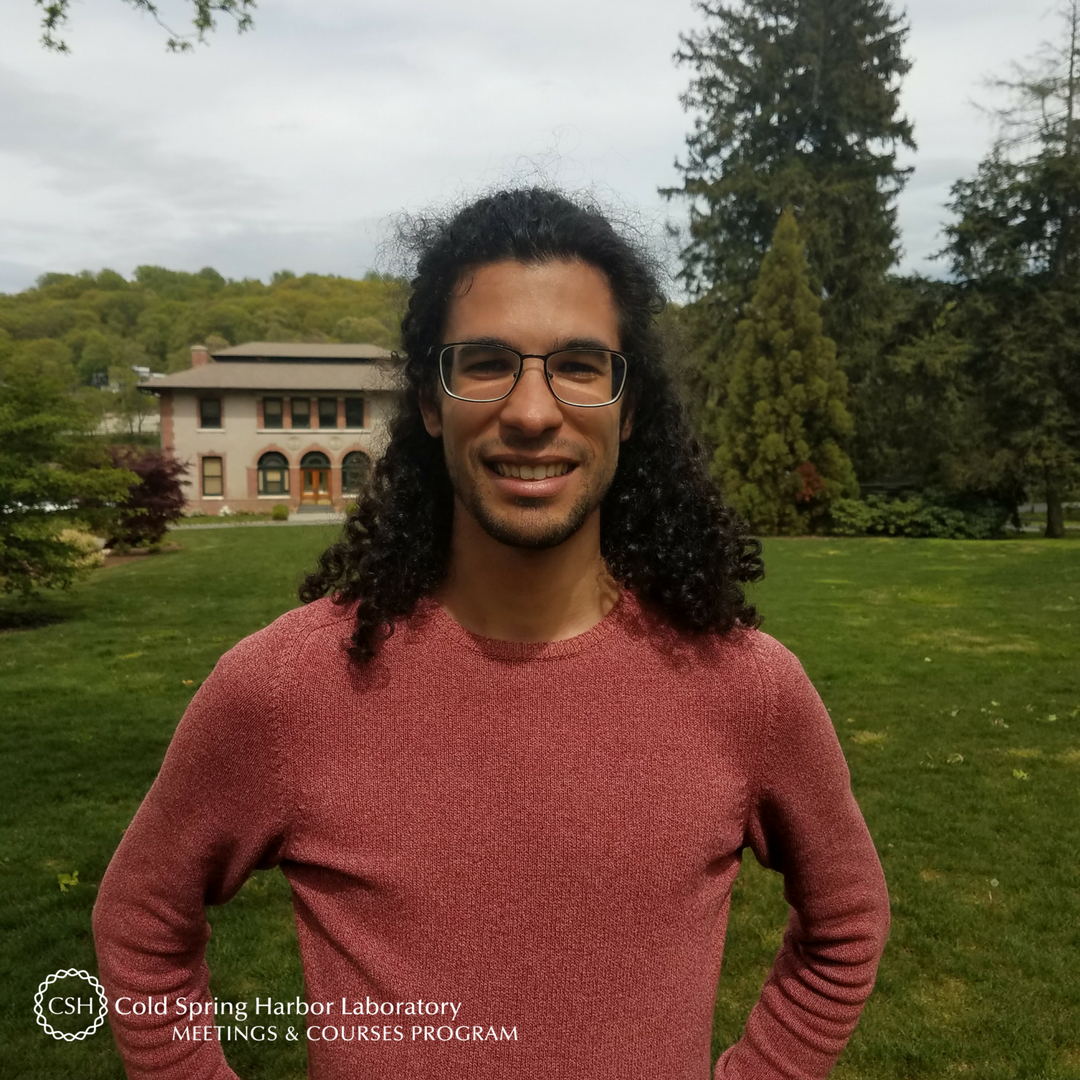
Meet Andre Rendeiro of CeMM Research Centre for Molecular Medicine of the Austrian Academy of Sciences (Austria). Andre is a PhD student at Christoph Bock's lab and is on campus for The Biology of Genomes, his very first CSHL meeting. He presented a poster today titled "Pooled CRISPR Screening with Single-Cell Transcriptome Readout". Read on this first-timer's take on the meeting.
What are you working on?
I study how variation in gene regulation helps explain phenotypes during normal development but more specifically in human leukaemias.
What is your key takeaway from the Meeting?
Knowledge in biology is accelerating at an extraordinary pace and is definitely the science of the 21st century.
How many CSHL meetings have you attended?
This is my first and I would most likely attend another one in the near future.
Was there something specific about The Biology of Genomes meeting that drew you to attend?
I was drawn to the fact that this is a very well-known meeting and it is set in a historic place for science. Additionally, a lot of the talks are relevant to my research topic and it is always great to meet people doing great science in the areas of genomics and gene regulation.
If someone curious in attending this meeting asked you for feedback or advice on it, what would you tell him/her?
The CSHL campus is beautiful and worth a visit by itself. The meeting has a dense and demanding program but there are still plenty of opportunity to meet and network with other attendees.
What do you like most about your time at CSHL?
I met a lot of great people, and the perfect weather helped me to enjoy the campus.
Thank you to Federica and Andre for being this week's featured visitor. To meet other featured scientists - and discover the wide range of science that takes part in a CSHL meeting or course – go here.
A Word From: Roger Reddel

Roger Reddel (R)
This week, we hosted the tenth CSHL meeting on Telomeres & Telomerase. Since it was first held in 1999, the meeting has consistently attracted a large number of junior scientists: more than half the participants have been graduate students or postdoctoral scholars overall, and 55% of this year’s attendees are junior scientists. Women are also well-represented at the meeting: they make up 46% of the meeting participants across all ten iterations and 48% of this year’s attendees.
We checked in with Roger Reddel, a long-time participant and returning organizer, to get his take on the meeting and how it continues to serve the telomere community.
The program for each of the ten meetings has been organized according to the same set of principles, with essentially all of the talks being chosen by the organizers from submitted abstracts, based on the quality of the abstracts, how well they fit with the session themes, and the requirement that most of the data must be unpublished at the time of abstract submission. The session chairs are invited to nominate for oral presentation one abstract from their own lab that meets these criteria. Model organism research is always very well represented.
The talks and posters at the 2017 meeting have demonstrated the continuous, exciting advances being made in most areas of telomere research, with much of the recent progress resulting from creative applications of new research technologies. Also, attendance at this meeting has been very similar to previous years—despite visa problems experienced by some of our colleagues—which I think reflects the pivotal role it continues to play in this research area.
Thank you to Roger for taking the time to chat with us. For more conversations with our other meeting organizers and course instructors, go here. Also, to gain a participant’s perspective on this meeting, read our Q&A with Borja Barbero.
Visitor of the Week: Borja Barbero

Meet Borja Barbero of the Department of Biochemistry and Biophysics at Texas A&M University. Borja (pronounced bor-ha), a Spanish national and second year graduate student in the Shippen Lab, is on campus for the 2017 Telomeres & Telomerase meeting where he presented a poster. Read on to learn about the CSHL first-timer's work and refreshing take on the meeting.
What are you working on?
My focus is on plant telomeres. More specifically, I work on Arabidopsis Thaliana POT1B, a negative regulator of telomerase that seems to have evolved a role in plant development.
What is your key takeaway from the Meeting?
My key takeaway is something Dr. Tom Cech said at the beginning of one of the sessions: "The research presented in these presentations are incomplete; however, with discussions among colleagues, we can make it more complete."
How many CSHL meetings have you attended?
This is the first meeting that I have attended at CSHL and, so far, it has been great. I hope to come back for the next Telomeres & Telomerase meeting.
Was there something about the Telomeres & Telomerase meeting that drew you to attend?
I was given the opportunity to present a poster at this meeting. It was a really good experience since I received excellent feedback from the telomere community.
If someone curious in attending this meeting asked you for feedback or advice on it, what would you tell him/her?
That this meeting is definitely an excellent chance to hear new insights on any scientific field from the brightest minds in the world.
What do you like most about your time at CSHL?
I enjoy the enthusiasm and scientific spirit -- everyone is so driven to push science forward.
Thank you to Borja for being this week's featured visitor. To meet other featured scientists - and discover the wide range of science that takes part in a CSHL meeting or course – go here.