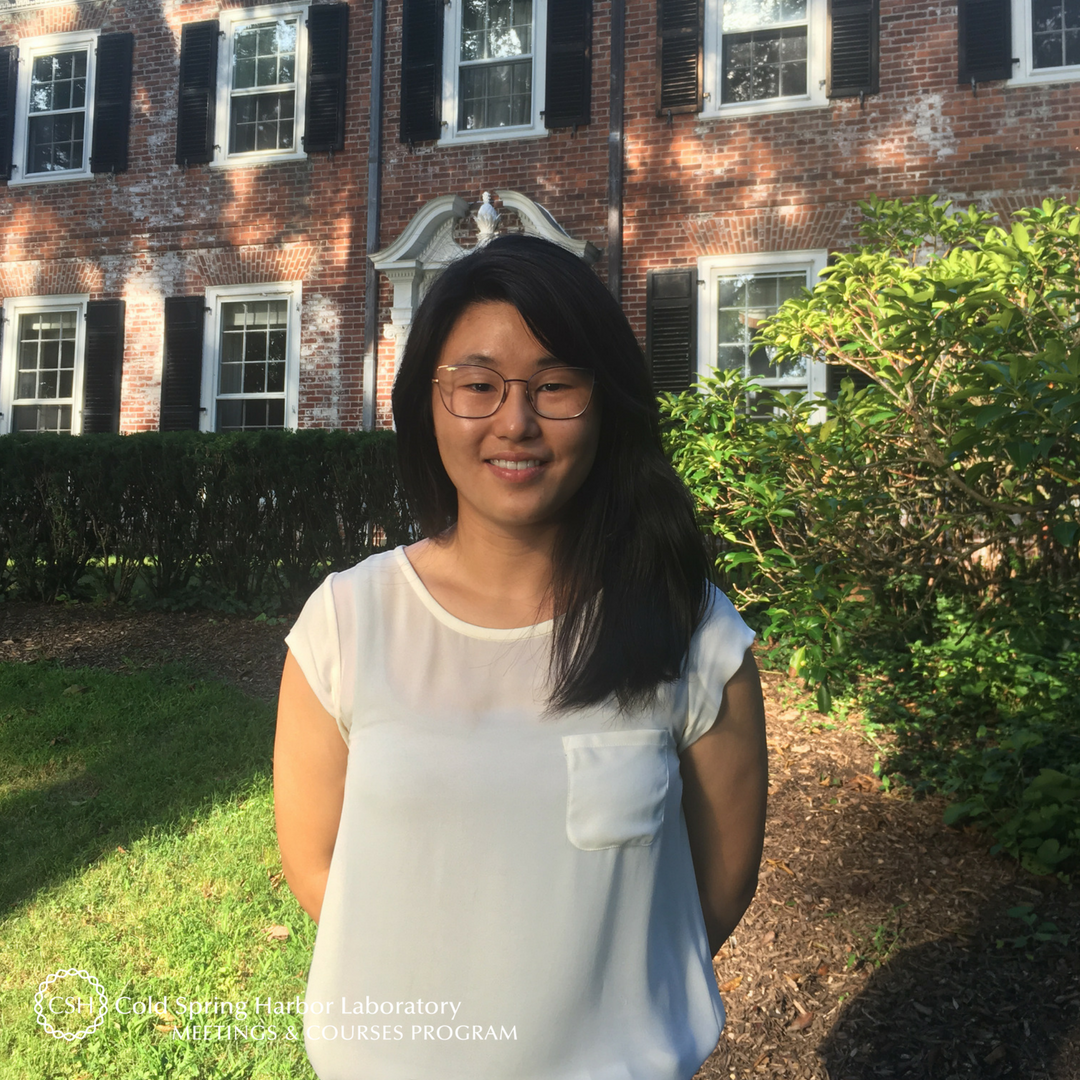
Visitor of the Week: Dawoon "Sheri" Choi

2018-visitor-dawoon-sheri-choi

Meet Dawoon “Sheri” Choi of the University of British Columbia (Canada). The graduate student is a member of Janet Werker’s Infant Studies Centre. She is on campus wrapping up her training at the Genetics & Neurobiology of Language workshop.  

What are your research interests? What are you working on?
Broadly speaking, I am interested in how human infants acquire speech. The focus of my research is on early speech perception; specifically, on the perceptual biases and neuro-cognitive mechanisms that may allow infants to be successful language learners. 
 
How did you decide to make this the focus of your research? 
Language and speech are uniquely human processes. Despite the complexities inherent in languages, infants are able to learn their native speech without explicit tutelage or guidance. I wanted to focus on infants because of this unique capacity. We know that there are cascading processes that occur early on that sets the stage for language usage for the rest of the lifespan, and by better understanding the perceptual biases that contribute to the scaffolding of language learning, I hope to understand the important element of human speech. 
 
How did your scientific journey begin? 
After finishing my undergraduate degree in Psychology at McMaster University. I moved to Trento, Italy to pursue a Masters in Cognitive Neuroscience at CiMeC, where I became better equipped at understanding neuroimaging techniques. Due to the great facilities and world-class research, I was inspired by the research on the brain dynamics underlying perception. I wanted to apply the skillsets acquired during my training to understand speech perception during development.  
 
Was there something specific about the Genetics & Neurobiology of Language course that drew you to apply?
I wanted to apply to the course because it brought together researchers from diverse fields with different research programs who converge on the goal of understanding the human faculty for language. Since the study of language requires you to think and understand it from multiple perspectives, I felt that the interdisciplinary aspect of the workshop would allow me the unique opportunity to learn -- in depth -- the specific research questions addressed by world-renowned researchers.
 
What and/or how will you apply what you've learned from the course to your work? 
The course helped to broaden my perspective on both the theoretical issues and research programs currently making new grounds in speech and language sciences across the spectrum. I also learned to read and think more critically about the studies from different fields that I haven’t had training in, such as genetics or patient studies, as the researchers placed emphasis on conveying the basic methodological principles used in their fields. I’m thinking about how these processes may be informed from a developmental perspective, and conversely, what questions can be asked in the developmental population to contribute to the debates. 
 
What is your key takeaway from the course?
My main takeaway from the course is that language is complex, and an approach whereby we examine the core problem from multiple perspectives is necessary to tackle the broader goal of understanding the human faculty for language.  

If someone curious in attending this course asked you for feedback or advice on it, what would you tell him/her?
I very highly recommend attending this workshop for any researchers interested in language and speech. The scope of topics in the course is wide but one starts to see the links and how they may inform one another. It’s a great example of why an interdisplinary approach to language research is so important. 
 
What do you like most about your time at CSHL?
The campus and the Banbury Conference Center provides a relaxing and idyllic atmosphere that helps to facilitate the formation of dialogue very naturally. Working with and getting to know all of the participants of the course was an invaluable experience.  

Sheri received financial support from the Nancy Lurie Marks Family Foundation to cover a portion of her course tuition. On behalf of Sheri, thank you to the Nancy Lurie Marks Family Foundation for supporting and enabling our young scientists to attend a CSHL course where they expand their skills, knowledge, and network.

Thank you to Sheri for being this week's featured visitor. To meet other featured scientists - and discover the wide range of science that takes part in a CSHL meeting or course - go here.

Photo: Sheri Choi

Visitor of the Week: Sophia Heyde

2018-visitor-sophia-heyde

Meet Sophia Heyde of the Novo Nordisk Foundation Centrer for Biosustainability at the Technical University of Denmark. The PhD student is a member of Morten Nørholm’s lab in the Microbial Evolution and Synthetic Biology group. Sophia has been on campus for the last two weeks training at the annual course on Synthetic Biology

What are your research interests? What are you working on?
I am a young scientist driven by the potential of producing biochemicals through engineering of cell factories in order to advance towards a greener, more sustainable future. My PhD project, therefore, addresses host intolerance of microbes used for production -- a major bottleneck in metabolic engineering -- and involves the investigation of a novel experimental evolution approach called retromutagenesis. 

How did you decide to make this the focus of your research? 
The possibility to perform research for a future beneficial to human kind. We can no longer deny challenges like climate change, the decreasing supply of petroleum, or the vast amount of plastics floating in our oceans. It is time to develop solutions for a greener and more sustainable future and it is (and always has been) my goal to contribute to this important task. 

How did your scientific journey begin? 
Thanks to my very ambitious high school biology teacher, who organized multiple excursions to universities and research centers to show us “real” science, I became interested in science and inspired to become a researcher myself. I started studying biology and during my bachelors, my focus on biotechnology and metabolic engineering intensified after a very inspiring talk by Jay Keasling I heard at an EMBL Heidelberg conference. 

Was there something specific about the Synthetic Biology course that drew you to apply?
I was especially interested in gaining experience in new synthetic biology approaches such as cell-free transcription and translation systems (TxTl) and RNA circuit design, and connecting classical wet lab synthetic biology tools with modelling approaches. 

What and/or how will you apply what you've learned from the course to your work? 
Personally, I found the course to be extremely inspiring and will apply this fresh excitement into my project at my home institution. I learned to approach problems in different ways. The modelling and circuit design module, for example, showed me that looking into a biological problem in a more modular way can spark new ideas and point out experimental design bottlenecks that weren’t before taken into consideration. 

Also, when working on the topic of evolution in my home institution, I will also remember a key statement from Francis Arnold’s talk: whenever performing evolution experiments, have a strong bias towards what you are screening for.  

What is your key takeaway from the course?
Approaching a problem or question with a diverse set of perspectives -- especially when working alongside researchers with totally different backgrounds -- can lead to extremely fruitful discussions and high-quality solutions. 

How many CSHL courses have you attended? Have you participated in a CSHL meeting?
This is my first one, and I would love to attend a meeting at CSHL in the future!If someone curious in attending this course asked you for feedback or advice on it, what would you tell him/her?
This course offers a unique chance to learn and practice cutting-edge synthetic biology methods in a world-class environment. Hearing from the first-hand experience of well-chosen researchers and speakers opens an extremely inspiring and captivating learning environment. Participating in the CSHL Synbio course is a great experience and does not just enlarge your scientific skill set but also your social skills because you interact with a diverse group of interesting people from all over the world.

What do you like most about your time at CSHL?
The very open and non-competitive atmosphere of the course led to a lot of creativity, inspiration, and all of us becoming really good friends in a very short amount of time. We had a lot of fun together inside and outside the lab: spontaneous canoe rides during incubation times, midnight swims, daytrips to NYC, and table football tournaments. 

Sohia received financial support from the Howard Hughes Medical Institute (HHMI) to cover a portion of her course tuition. On behalf of Sophia, thank you to HHMI for supporting and enabling our young scientists to attend a CSHL course where they expand their skills, knowledge, and network.

Thank you to Sophia for being this week's featured visitor. To meet other featured scientists - and discover the wide range of science that takes part in a CSHL meeting or course - go here.

Photo: Constance Brukin

Working a CSHL Meeting

Connection is at the heart of every CSHL meeting; many of which include ancillary events beyond the standard oral and poster sessions that provide participants with a casual atmosphere to meet, speak with, and learn from one another. This post will orient and guide you through our Career Dinners and Meet the Speakers luncheons as well as two tools that are essential for nearly all scientists: elevator pitches and networking (while introverted).

Visitor of the Week: Artemiza Martinez

2018-visitor-artemiza-martinez

Meet Artemiza Martinez of the International Laboratory of Human Genome Research (LIIGH) at the Universidad Nacional Autonoma de Mexico. Artemiza did her undergraduate studies at LIIGH before transitioning into a research assistant in Lucia Morales’ Yeast Genome Evolution lab. The Mexican national is on campus training at the Yeast Genetics & Genomics course where she is expanding her knowledge of yeast and gaining wet lab experience to further strengthen her PhD application. She also talks about the crowdfunding campaign she set up to fund a portion of her tuition. 

What are your research interests? What are you working on?
I am working to understand evolutionary processes using yeast as a model system. In the lab, we are working with hybrid yeasts to understand the process of hybridization. At the same time I love fermentative processes because it’s really interesting how yeasts perform to obtain different products like wine. 

How did you decide to make this the focus of your research? 
Because there are so many different topics I am passionate about and could be happy working with, I wasn’t entirely sure what I want to study until recently. My various research internships and undergraduate thesis guided me towards studying yeast genetics, and I really love what I do.

How did your scientific journey begin? 
In high school I took a genetics class and it was my favorite. After reading an article on the applications of microorganisms in many of the products we use daily, I decided to study biotechnology. I became even more passionate about science during my undergraduate thesis work at LIIGH and  thanks to the investigators who work there and shared with me their life stories and the importance of scientific research. 

Was there something specific about the Yeast Genetics & Genomics course that drew you to apply?
I was motivated by my desire to learn more about yeast and to strengthen the base for my doctorate. In LIIGH, we normally focus on bioinformatics analyses so we have little wet lab experience. Many of the techniques in the course are of great utility to answer future questions in the laboratory, and I am certain this course will develop my skills and knowledge of lab protocols and methodologies.

You created an online fundraiser that helped raise funds to attend the yeast course - talk us through what brought on the initiative.
Because the US dollar has been very strong compared with my national currency (the Mexican peso) it was very difficult for me to pay for the course. Thankfully, I was able to receive financial support from the Helmsley Charitable Trust and HHMI but I needed to raise the funds to cover the remaining balance. And since attending this course is an opportunity I could not let go to waste, I decided to set up a fundraiser. My goal was $1,756 USD (which includes Donadora’s commission) and I am happy to announce that I achieved my goal. I am very thankful for the many people who donated and helped make possible my attendance to this course, and now it is my duty to learn and share my knowledge in my country.

Would you recommend future course trainees to start their own online fundraising campaign to help finance their participation in a CSHL course? 
It is a good option for those who lack the funds to attend the course but it will require time to put together and get off the ground. I spent hours contacting people to convince them of the benefits of my attending a training course in the US and inform them of my fundraiser. This was hard and frustrating at first but when the donations began to come in, I felt nothing but joy and gratitude. Now, I feel even more motivated to achieve my goals which I share with those who supported me and expect the best of me.

What and/or how will you apply what you've learned from the course to your work? 
Many of the methodologies being discussed and shown in the course are necessary for the project on which we are working. My intention is to be able to transmit this knowledge to the new students entering the lab who are interested in working with yeast.

What is your key takeaway from the course?
That working in the lab can be so much fun! I have gotten to know experienced researchers working on very interesting topics who are further motivating me to pursue my goals. The ability and opportunity to share what you do and your passion for science with people from all over the world is a very gratifying sensation.

How many CSHL courses have you attended?
This is my first course in CSHL, I hope it is not the last.

If someone curious in attending this course asked you for feedback or advice on it, what would you tell him/her?
It is an intense course that demands all your energy but it is totally worth it. The instructors and teaching assistants put so much effort and joy into preparing and teaching that instead of feeling tired, you become curious and ready to learn more and take full advantage of the course. And of course, you cannot miss out on the opportunity to train at such a beautiful institute.

What do you like most about your time at CSHL?
Learning science here is fun and every day there is something new to enjoy.

Artemiza received a scholarship from the Helmsley Charitable Trust and financial support from the Howard Hughes Medical Institute (HHMI) to cover a portion of her course tuition. On behalf of Artemiza, thank you to the Helmsley Charitable Trust  and HHMI for supporting and enabling our young scientists to attend a CSHL course where they expand their skills, knowledge, and network.

Thank you to Artemiza for being this week's featured visitor. To meet other featured scientists - and discover the wide range of science that takes part in a CSHL meeting or course - go here.

Visitor of the Week: Predrag Janjic

2018-visitor-predrag-janjic

Meet Predrag Janjic of the Macedonian Academy of Sciences and Arts (Republic of Macedonia). Predrag is associated with the Laboratory of Complex Systems and Networks led by Ljupco Kocarev, and with the Research Program in Psychiatric Diseases led by Andrew J. Dwork of the New York State Psychiatric Institute at Columbia University. The research scientist is on a multi-week trip in New York – first to take part and present a poster in the 2018 Glia in Health & Disease meeting titled “Multistability in a model of membrane voltage dynamics in hippocampal astrocytes—Interplay between Kir and K2p currents” and then to meet with his States-side collaborators.

What are your research interests? What are you working on?
The main focus of my present work is computational modeling of glial cells, both their structure and function. Within the structural studies we try to quantitate myelin in psychiatric disease, while on the functional side, I develop dynamical models of conductivity of astrocytic membrane.

How did you decide to make this the focus of your research?
While I knew cell-level modelling would be the focus of my work, as I was considering the particular phenomena I should concentrate on, it was a striking realization that computational cellular neuroscience had almost completely ignored glial cells during the last few decades, or have modeled their roles in a rudimentary way. From a biophysical perspective, I found it unacceptable and decided to take a closer look into how biophysical theory could describe some of the basic experimental properties. For getting into closer contact with the real issues and challenges, apart of the collaboration with Columbia University on myelin, for functional cell-level modelling I collaborate with Prof. Christian Steinhaüser’s lab in Bonn and Prof. Pavle Andjus’ lab in Belgrade where advanced neurobiology of glia is being explored experimentally.

How did your scientific journey begin? 
After graduating with a degree in electrical engineering and computer science, I pursued a masters in the theoretical physics of nonlinear phenomena from Ss. Cyril and Methodius University in Skopje; where my interest in dynamical descriptions of neuronal membranes began. The freedom I was given by Prof. Kocarev to explore less established areas enabled me to carry over my earlier interest into Ph.D. studies, focusing on the variations of modeling frameworks in non-excitable (or non-spiking) cells. The NIMH/Fogarty-funded research led by Columba University provided me with the critical opportunity to join a larger research program and pursue neuroscience.

Was there something specific about the Glia in Health & Disease meeting that drew you to attend?
I was attracted by: 1) the growing evidence from several labs that specific glial potassium-channel families (which I study) are implicated in more and more disordered conditions, and 2) the possibility to have face-to-face discussions on those implications and experimental observations.

What is your key takeaway from the meeting?
During the last several years, I have struggled to find my home community. The computational neuroscience community – where I belong on paper – still unfortunately stands aside on most of the glial phenomena. On the other hand, the concepts and methods used by the computational neuroscience community are still a bit abstract for the glial biologists, where molecular studies presently dominate. Computational studies of glia will have to bridge the gap between the experimental observations and their quantitative descriptions, and CSHL is a very unique place where both experimentalists and theoreticians feel at home. The explosion of molecular findings will show  researchers like me where to look when refining the computational descriptions of the phenomena we observe.

What did you pick up or learn from the meeting that you plan to apply to your work?  
This was the first meeting I attended where a notable number of leading researchers in glial biology were present. I needed to get a first-hand account of the molecular studies aimed at showing what (de)regulates the ion channel populations I am quantitatively modeling, as well as what is the latest in the imaging and molecular studies of myelin. 

If someone curious in attending a future iteration of this meeting asked you for feedback or advice on it, what would you tell him/her?
As the glial biology community is definitively growing, the Glia meeting at CSHL will further gain popularity. And since both, the cell-level and molecular biological contexts are addressed here, CSHL is really a great place to get inspired  while meeting and working with other glial biologists.

What do you like most about your time at CSHL?
The CSHL campus has a unique quality conducive to relaxing and thinking about what really inspires you. The history-rich facilities, artistic touches in each and every corner, supportive staff, and the great food will make anyone feel really pleasant.

Thank you to Predrag for being this week's featured visitor. To meet other featured scientists - and discover the wide range of science that takes part in a CSHL meeting or course - go here.