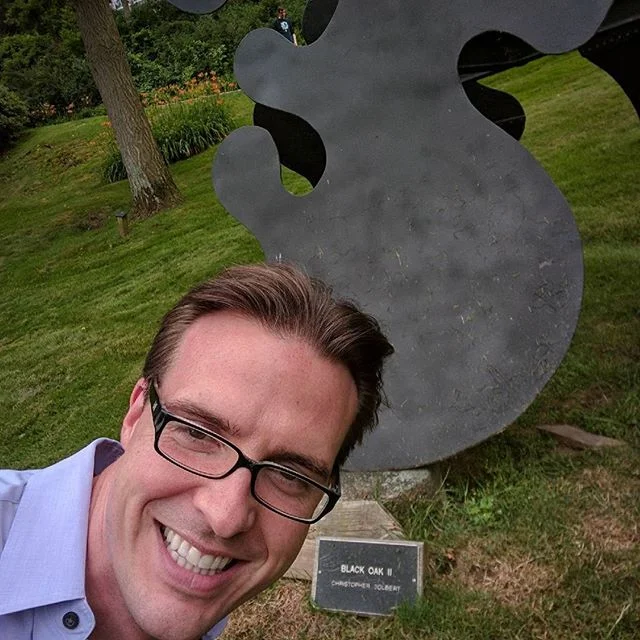
Last week, we met with Adam Rosebrock to chat about the CSHL Metabolomics course. Founded in 2016 by Adam, Amy Caudy, and Eyal Gottlieb, Metabolomics is one of our newer courses. The second iteration of the course this summer saw the addition of a fourth lead instructor – Justin Cross – as well as a broader applicant pool and a refinement of how trainees rotate through the instruments.
It’s been a fun trajectory watching the students go from really thinking of metabolomics as a black box to understanding how it works. We have students from computational backgrounds, biology backgrounds, even chemists merging together in this one science. They’ve been working together as a team and it’s fun to watch!
I think of these courses like science summer camp: participants have great shared experiences, become disconnected from the outside world, and build a group of friends with whom they stay in contact for years to come.
Are there any new developments in the field that are reflected in the course?
Metabolomics is an actively changing and growing field. And ‘Metabolomics’ means many things to many people; it’s a catch-all word that is incredibly overloaded. Each time we set up this course, we have to think about what metabolomics means in that specific year. We’ve shifted from discovering new compounds every time we do an experiment to accurately measuring a known list of compounds. The changes in these known compounds -- that we thought we knew everything about -- are the meat of the biological story. The regulation of metabolism is really what defines different cell types and different physiological states. Students are now having to turn their thinking from “I want to discover a new compound” to “How do I measure a large swath of chemical matter that’s inside the cell?”
Another major change is the development of new software tools. One of the reasons students from computational backgrounds are great to have in the course is because they can get a better idea of how the data they analyze are generated.
The course is very technology-driven. Metabolomics is underpinned by mass spectrometry, and instrument vendors are actively changing their offerings as this science becomes a larger part of what we do in the biological community. Every year we have to learn, as instructors, the new toys and tools out there to ensure the course stays current. It's a fantastic opportunity to see first-hand how vendors improve their offerings to suit the changing needs of science.We have about $2.5 million worth of loaned instrumentation that students get to use hands-on during this course. So what we have is sort of like a flash-mob version of a core facility with high-end, top-of-the-line instruments. It’s a fantastic way for students to come in and have expert practitioners in the field – the instructors – set up machines for them to use. Although a lot of metabolomics is mass spectrometry, we have stuff that people who don’t have mass spectrometers can do, too; you don’t have to have a mass spec in your own lab to do the analyses we teach in the course.
We requested a description of a day-in-the-life of a Metabolomics trainee and, by the sound of it, they are kept quite busy!
The Metabolomics course is intense – science starts at 9 AM and many students don’t head home until nearly midnight. The goal this year was to have a common, defining thread: Students can see how the many different tools of metabolomics analysis play into a single experiment.
At the beginning of the course, students are asked to give a two-slide pitch on why they chose the course, what metabolomics means to them, and what they want to get out of it in terms of the science. There’s a significant amount of lecture-based learning from my co-instructors and myself where students learn fundamental technologies, applications of different tools and algorithms to biological questions, hands-on time on high-end instruments, and the basic processes in designing and executing metabolomics experiments. The 16-student cohort is split off into smaller groups so that everybody has a lot more hands-on time with both instructors and instruments.
But that’s only part of what we do here. On top of the hands-on and lecture-based learning, students hear talks from more than a dozen invited speakers in metabolism. Each speaker gives a gloves-off chalk talk in the evening after dinner that is meant to be interactive, so the students are able ask questions and figure out tools the speaker used to enable his/her research. The students usually see these invited chalk talks at a time in the course when they’ve just learned the tools from us. The next day, the same speaker gives a more formal 50-minute talk that provides a distillate of the technologies, tools, and ideas into a formal scientific package.
We’ve also designed a good amount of time for students to propose projects that they would like to execute back in their home institutions. The capstone of the course is for students to tell us what experiment they’re going to do first back home with the tools they currently have, as well as what they would like to do at their home institution but can’t. The idea is to foster collaboration; together, the cohort of students can critique ideas and designs given what they’ve all learned in the course.
We switched gears and talked about the students themselves:
This year, we wanted to bring in a wide range of scientists from different disciplines. I was really stunned by the quality of applications we received: they all asked how they could apply small-molecule metabolism analysis to their science. We have students from the National Institute of Standards and Technology, cancer biologists, and also scientists involved in microbiology and biofuel production.
The applicant pool was also diverse in age this year. We have students who are as young as first-year graduates or MD-PhD students, and they bring a totally unbiased perspective to science, a real love for learning. They’re able to keep up with the senior graduate students, postdocs, and faculty who make up the rest of the class. They’re all getting along very well, and the age disparity that I initially thought might be a problem has turned out to be fantastic. It created a balance in the student body: the younger students add a spark while the older scientists provide perspective.
We then looked forward to next year’s application process and applicant pool:
We would love to take twice as many students next year if we could. Unfortunately, we don’t have the bandwidth to do so. I think having a mix of computational and wet biologists is critical. Having a mix of young, fresh faces and grizzled scientists - like myself - is also critical. And certainly a mixture of model systems and kinds of biology is very important. So instead of just being a cancer metabolism course this really has, from the start, been a course about general methods for metabolism measurement and ways of computationally and directly measuring what happens biochemically inside the cell.
For those interested in attending the 2018 iteration of this course, Adam offers the following advice:
The biggest criteria my fellow instructors and I use in evaluating student applications is “Can you make use of this in your current projects?” Or “Are you turning to projects that will immediately use these tools?” Cold Spring Harbor Laboratory Meetings & Courses Program has a very selective course admission process and we can only take roughly 16 students a year. There are many who would love to learn the theory and perhaps the practice behind this science just to have that added to their knowledge set. But as much as we love teaching and learning, our main goal is to train the next generation of scientists who can take these tools into the greater scientific community.
The Metabolomics course may have just finished its second iteration, but it has already been mentioned and recognized in publications.
I recently attended the American Society for Mass Spectrometry meeting which is an international meeting of a diverse range of mass spectrometrists, including metabolomists. At that meeting and many others I’ve been to over the last year, it’s been fantastic to see alumni from our 2016 course presenting talks and posters, demonstrating the power of this course and its effects on the greater science community. We’ve already been acknowledged in 1 publication, with another in the final phase of revisions.
We concluded our conversation discussing how Adam sees the field of metabolomics evolving, and the overall goal he and his co-instructors have for course alumni.
While we do our best to present students with a wide range of different scientific approaches and technologies, there’s no way to encapsulate all of metabolomics into a 2- or 3- week course. Our main goal is to foster independent, metabolomics-empowered scientists.
As metabolomics becomes a more mature field, it will be easier to have the actual measurements done by somebody else. Therefore, we try to teach students how to think about the design of an experiment -- to make a proper contrast to ask the question they want and then, with the raw data, figure out what’s inside and make their own scientific interpretation. That way, in a future where the mass spectrometry happens in some distant core facility, the students are still empowered to design proper experiments, generate biological samples that can be run through a mass spectrometer elsewhere, analyze the data, and make their own biological conclusions.
Thank you to Adam for taking the time to chat with us. For more conversations with our other meeting organizers and course instructors, go here. Also, to gain a trainee's perspective on the Metabolomics course, read our Q&A with Vita Stepanova.